
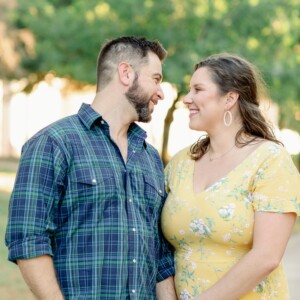
The work we do at the Veteran Spouse Network (VSN) is incredibly personal to me. I live and breathe this life and wholeheartedly believe that I may not have ended up with the happy and healthy marriage–or the 2 beautiful children that I have today–if it weren’t for the connection and the support I received from this community.
Because peer support is at the core of what we do, I feel a responsibility to share my story whenever I can. When I started working at VSN nine years ago, my now husband and I were not in a good place, and I truly didn’t know if our relationship would make it.
So, I share my story often, whether it’s in blogs like this, podcast episodes, at speaking events, or when I talk one-on-one or in groups with our participants. When I share my story, the responses I get both break and fill my heart.
So many of you reach out and say some version of the same thing:
“I’m where you were. How do I get where you are?”
And every time, I find myself giving the same disclaimer:
“You are not me. Your spouse is not my spouse. What worked for us may not work for you.”
That statement is true. It’s important. Every relationship is different, every experience with PTSD is different, and every individual is different.
But every time I say it, it feels…unhelpful.
Because when you’re in the thick of it, what you’re often looking for isn’t just a listening ear, but something steady to hold onto, some tangible action to take to make things better.
So, while there is no one-size-fits-all formula, I do believe there are truths that apply across all relationships. Principles that can help guide you and honest questions you can ask yourself to make the path forward a little clearer.
These are the things that, in my experience, always matter.
1. Know What You Want
Before anything can change in your relationship, you need clarity within yourself.
Ask yourself:
- “Do I want to be in this relationship?”
- “What isn’t working for me right now?”
- “What would a healthy, successful relationship look like for me?”
It’s easy to get consumed by your partner’s needs, their diagnosis, and their healing, but your needs matter equally. If you don’t know what you want, you’ll have no way of knowing whether things are getting better or whether you’re slowly losing yourself.
2. Decide If This Is Worth Fighting For
Loving someone with PTSD can be deeply meaningful, but it can also be incredibly hard.
This is not a passive relationship. It takes effort, patience, and the willingness to grow. Sometimes more than you ever imagined you had.
Ask yourself:
- “Is this relationship worth that level of investment for me?”
- “Is this the life and relationship I want?”
There’s no right or wrong answer. Deciding this isn’t what you want—or that it’s not worth the toll it takes—may feel selfish or unfair, but it’s an honest answer you owe yourself.
Because staying without intention leads to resentment. And leaving without clarity can leave you questioning everything.
While knowing that you want to fight doesn’t automatically make it all better, it does make things easier. You know what you’re fighting for, and you know it’s a fight you want to be in.
This was huge for me.
When I first met my now-husband, Cody, within an hour of knowing him, I knew he was someone I wanted in my life. Fast forward a few hours, and I knew I wanted more than friendship. In a few months, I knew he was my person.
And while that made the hard seasons incredibly painful–wondering how I would survive losing my person–it also grounded me. When everything felt out of control, one thing was clear:
He mattered. We mattered. And I wanted to fight for us.
That didn’t mean I didn’t question myself. I did, often.
“Was I being delusional? Trying to force something that wasn’t working?”
But I always came back to the same answer: for me, this was worth fighting for.
3. Understand and Honor Your Boundaries
Love without boundaries is not sustainable.
Ask yourself:
- “What are my hard lines?”
- “What behaviors can you not tolerate?”
- “What do I need to feel safe, seen, and supported?”
PTSD can explain behavior, but it does not excuse it. You are allowed to say:
- “This is not okay.”
- “I need something different.”
- “I deserve to feel safe in this relationship.”
Boundaries are clarity, not ultimatums, and they are an essential part of relationships.
One of the most important boundaries I set was this: I would not engage with my husband during an episode if it felt emotionally unsafe. When I was no longer his partner but his enemy, I disengaged. That often meant physically removing myself, so we could both regulate.
The second and equally important part? We always came back to the conversation afterward. I would share what happened and how it impacted me. He would hold space. And together, we would figure out what needed to change.
And let me be clear, this was incredibly hard. I didn’t always hold my boundaries perfectly. No one does.
The goal is progress, not perfection.
4. Remember Communication Is Everything (Even When It’s Hard)
If I’ve learned anything, personally and professionally, it’s that communication is the foundation of every relationship, and most of us are not very good at it.
We expect our partners to:
- Read our minds
- Understand our emotions without explanation
- Know what we need without us saying it
And PTSD makes communication even harder. Many veterans struggle with emotional safety, connection, vulnerability, and expression.
But even so, communication has to happen. Not perfectly, but intentionally.
Here’s the key distinction: you cannot have a healthy, productive conversation in the middle of a PTSD episode. But you can afterwards.
That’s where growth happens.
So say the thing. The uncomfortable thing. The thing you’ve been carrying. Schedule intentional time to talk about what’s working and what isn’t.
And never stop doing it.
Creating emotional safety and support in your relationship begins and ends with communication.
5. Lean On Your Own Support System
This is one of the most overlooked and most essential parts of this journey.
You cannot do this alone.
Loving someone with PTSD can be isolating. It can distort your sense of what’s normal, what’s acceptable, and what’s actually happening in your relationship. Over time, it can become harder to trust your own perspective. That’s why support matters.
Peer Support: Reality Checks with People Who Get It
There is something uniquely powerful about talking to people who truly understand what it’s like to love a veteran with PTSD.
Peer support gives you something invaluable: a place to measure your reality against someone else’s.
People who understand help you ask:
- “Is this normal?”
- “Am I making excuses?”
- “Am I minimizing things that matter?”
- “Am I expecting too much?”
They can help you see progress more clearly or recognize when you might be stuck in patterns that aren’t serving you.
And most importantly, they remind you that you’re not alone.
Professional Support: Objective, Honest Guidance
While peers bring shared experience, professionals bring objectivity.
A good counselor helps you:
- Clarify what you want
- Understand your patterns
- Process your experiences
- Move toward a healthier, more aligned life
They are not emotionally entangled in your relationship. They’re not influenced by your history, hopes, or fears in the same way you are.
And sometimes, that objectivity is exactly what you need to answer the hardest question: “What is actually best for me?”
A professional can help you explore that honestly without judgment, and without trying to push you toward a specific outcome.
Support Is a Necessity, Not a Luxury
You cannot pour from an empty cup. I was at my lowest when I didn’t have my own support. It wasn’t until I found it–through both peers and professional support–that I even stood a chance.
Getting support doesn’t mean your relationship is failing. It means you are taking responsibility for your own well-being.
And in a relationship shaped by PTSD, that isn’t optional.
6. Gauge If This Is Working
This is the question that often gets overlooked, and when it is, suffering can continue with no clear end in sight.
When PTSD is part of your relationship, it’s easy to explain everything away.
As spouses, we might think:
“It’s not their fault. That’s the PTSD.”
And there is truth to that. But here’s the harder truth: explanation does not equal permission.
What matters is what happens after the episode.
- Do they create space for you to share?
- Do they listen—or become defensive or combative?
- Do they shut down, walk away, or disengage?
Most importantly:
- Do they care?
- Do they want to change?
- Do you see them making any effort to change?
PTSD is a lifelong reality for many veterans, but recovery and growth are possible.
Not overnight. Not without setbacks. But it is possible. And it will never happen without a commitment to change.
Look for the signs:
- Are they trying, even in small ways?
- Are they working on communicating more clearly?
- Are they taking care of their own mental and physical health?
- Are they showing up differently, even just a little bit?
Effort matters. Intent matters. Progress matters. No matter how big or small.
Work On What You Can Control
What worked for my relationship may not work for yours, but these principles always apply.
This isn’t about fixing your partner or replicating someone else’s path. It’s about the work you can do:
- Getting clear on what you want
- Defining your boundaries
- Communicating your needs
- Caring for your own wellbeing
- Paying attention to effort and accountability
Loving a veteran with PTSD is not simple. It’s not linear. It will challenge you. But it will also make you grow.
I am a better person—for myself, for my husband, for our children, and for everyone else in my life—because I love a veteran with PTSD.
This was the right path for me. No one can know what the right path is for you; only you can decide that. My hope is that these reflections can help you do exactly that.
Know VSN Has Your Back
And if there’s one last thing I want you to take away, it’s this: you don’t have to navigate any of this alone.
The Veteran Spouse Network exists because of stories like mine and yours.
It exists because loving a veteran can feel isolating and overwhelming, especially when PTSD is part of the picture.
It exists so that you have a place to go where people get it.
- Where you don’t have to explain.
- Where you don’t have to justify.
- Where you don’t have to minimize your experience.
Whether you’re looking for connection, clarity, a reality check, or simply a place to exhale, that support is here.
This journey is yours to navigate, but you deserve people walking alongside you.
And that’s exactly why we do this work.